How chambers of commerce can use peer masterminds to increase member retention
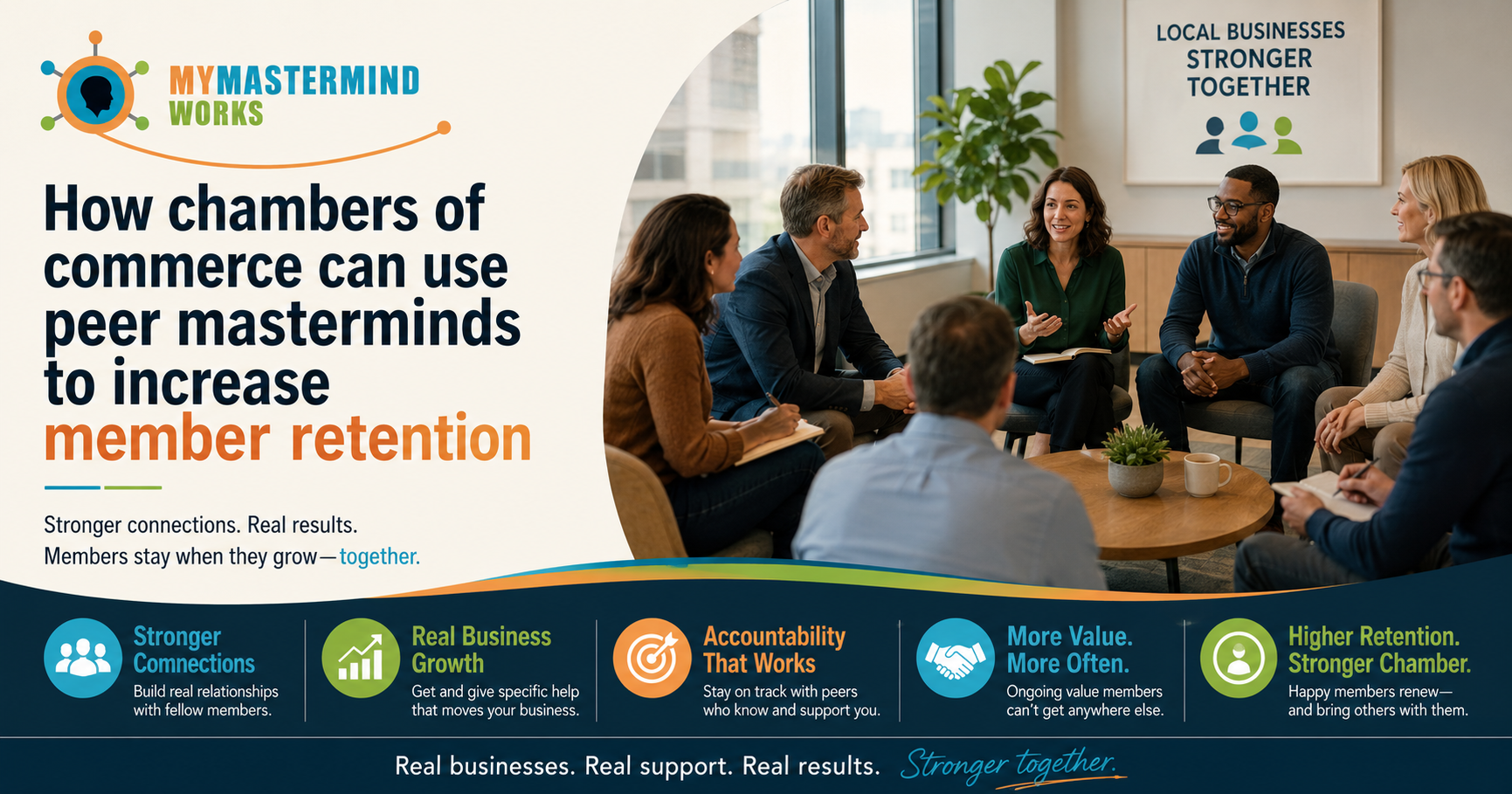
The average chamber of commerce loses between 20% and 30% of its members every year. The reasons members give when they don’t renew are almost always the same: “We didn’t get enough value.” “We never really connected with other members.” “It was just a directory listing.”
The chamber’s answer is usually more events. Another mixer, another ribbon cutting, another after-hours happy hour. And those things matter — but they don’t solve the underlying problem, which is that most chamber members are running their businesses in isolation. They attend an event, exchange cards, follow up with no one, and quietly conclude that the membership isn’t worth renewing.
A peer mastermind program solves a different problem than a networking event does. And that difference is worth understanding before deciding whether it fits your chamber.
What a networking event does vs. what a mastermind does
A networking event creates the possibility of connection. You’re in the same room as people who might be useful to you, and if you’re good at working a room, some of those possibilities become real relationships. If you’re not good at it — and most small business owners aren’t, which is why they joined a chamber instead of just cold-calling people — you leave with a stack of cards and no meaningful follow-through.
A mastermind creates an obligation of connection. You show up to the same group of people every two weeks. You’ve told them what you’re trying to accomplish. They know whether you hit your milestones last session. You know what they’re struggling with. The relationship is structural, not accidental — it doesn’t depend on anyone being good at small talk.
This is why mastermind members renew. Not because they got a deal at a ribbon cutting, but because there are eight people in a room who know their business, care about their progress, and will ask them directly what happened to the thing they said they were going to do.
The retention math
Consider what drives a member to renew. It’s almost always a relationship — a specific person they met through the chamber, a referral that came through, a deal that closed because of an introduction. The chamber isn’t the reason they renew; the relationship is. The chamber just gets credit because it created the context.
A mastermind program accelerates that dynamic deliberately. Instead of hoping that a member stumbles into a meaningful relationship at a mixer, you put them in a structured group where meaningful relationships are the explicit point. Every member arrives with a stated goal. Every member knows what every other member is working on. Help flows in both directions because the structure demands it.
The result: members who participate in a chamber mastermind program have a concrete, specific reason to renew that they can name. “My group” is a more powerful retention hook than “the events” because it’s personal, ongoing, and irreplaceable. You can’t replicate “my group” by joining a different organization.
What a chamber mastermind program actually looks like
The program doesn’t require the chamber to hire a coaching staff or build a curriculum from scratch. The facilitation model is simple: groups of 8-12 members, meeting every two weeks for 90 minutes, with a structured format that rotates the “hot seat” — one member gets the group’s full attention on their biggest current challenge, asks for specific help, and receives specific offers from peers who can actually provide it.
The chamber’s role is to curate the groups (mixing industries to prevent competitive tension, matching members by business stage rather than sector), provide the facilitation infrastructure, and give facilitators — who can be chamber staff, trained member volunteers, or contracted coaches — the tools to run the sessions without reinventing the structure every time.
The Ask/Offer mechanic is the engine: every member arrives with one specific request for help and one specific offer they can make to the group. Not vague goals, not status updates — a real ask (“I need an introduction to a commercial lender who works with manufacturers”) and a real offer (“I have a relationship with the city’s economic development office and can make introductions”). This turns the group from a support circle into a coordination engine. Help actually moves.
The visibility benefit chambers don’t usually talk about
There’s a secondary benefit to a chamber mastermind program that goes beyond member retention: early visibility into member distress.
In a traditional chamber model, a member is either attending events or they’re not. If they stop showing up, the chamber usually finds out they’re struggling — or that they’ve closed — when the renewal invoice bounces. There’s no mechanism for the chamber to know a member is in trouble until it’s too late to help.
In a mastermind program, a member’s plan is visible to their peer group every two weeks. When someone stops hitting milestones, when their goals get smaller instead of bigger, when they start missing sessions — the group notices before the chamber staff does, and the group can respond in ways that chamber staff can’t. A peer who’s been through the same cash flow crunch is more useful than a chamber staffer with a list of SBA resources.
This visibility is genuinely valuable to a chamber that takes its “support local business” mission seriously. It’s not just a retention tool — it’s an early warning system that lets the chamber actually do something when a member is struggling, rather than discovering the problem only after they’ve left.
How to start
A chamber doesn’t need to build this from scratch or run a pilot with fifty members. The right starting point is one cohort: eight to twelve members, one facilitator, ninety days. That’s enough to generate the first testimonials, understand what the format needs to look like for your specific membership, and decide whether to scale.
The selection criteria for the first cohort matter more than the size. Choose members who are already engaged — who come to events, who respond to emails, who have expressed frustration with isolation or with not getting enough from their membership. These are the members who will show up, participate, and tell other members what they got out of it. A strong first cohort creates demand for the second.
The chamber doesn’t need to run the facilitation itself. Coaches and facilitators who are already chamber members are natural candidates — they bring professional facilitation skill, they have a business interest in the program succeeding, and they’re already invested in the chamber’s success. A chamber that compensates its member-facilitators (from the program fee or from membership dues) creates a new value proposition for that segment of the membership too.
The retention problem chambers face isn’t really a value problem — it’s a visibility problem. Members don’t renew because they can’t point to something specific the chamber did for their business. A peer mastermind program makes the value specific, personal, and ongoing. That’s a different kind of membership benefit than a directory listing. And it’s one that’s genuinely hard to find anywhere else.
Prashant Sheth is the founder of MyMastermindWorks, a platform built to give chambers of commerce and coaches the infrastructure to run structured mastermind programs. MyMastermindWorks is part of the HumanismOS ecosystem, based in Austin, Texas.
Prashant Sheth is the founder of MyMastermindWorks and the HumanismOS ecosystem. He has spent fifteen years studying the conditions under which humans coordinate effectively.
Enjoyed this? Get the next one.
The Mastermind Journal lands in your inbox when there's something worth saying.