How to run your first mastermind session without a script — and what to do when it goes sideways
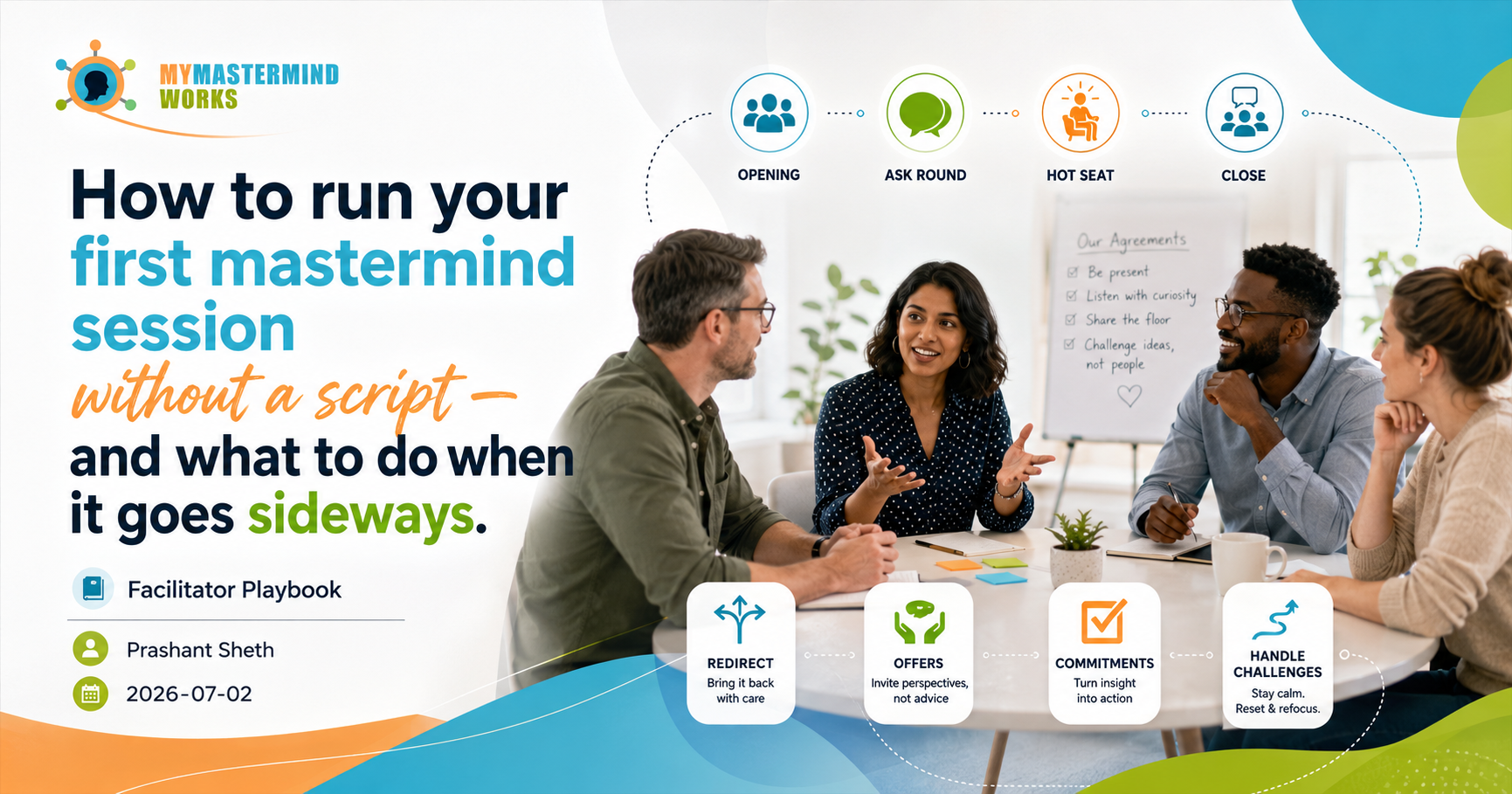
The first session is the hardest one.
Not because the material is complicated — the structure of a good mastermind session is actually quite simple. It’s hard because you’re establishing culture. Every choice you make in the first 90 minutes sends a signal about what this group is and how it works. Members are reading the room constantly: Is this safe? Are we being real here? Does this person know what they’re doing?
The good news: you don’t need a script. You need a structure and a clear sense of what your actual job is.
Your job is not what you think it is
Most new facilitators come into the first session with the same fear: what if someone asks something I can’t answer?
This fear misunderstands the role. The facilitator’s job is not to answer questions. It’s to create the conditions under which the group generates answers — answers that are almost always better than anything you’d produce alone, because they draw on the lived experience of everyone in the room.
Your job is structure, pace, and safety. You decide what happens next and when. You make sure the person speaking has the floor without interruption. You protect the group from spending forty-five minutes on one person’s problem while three others check their phones. You name what’s happening when the conversation drifts. You don’t need to know more than the members about their businesses, their industries, or their challenges. You need to know more than they do about how a room of people can think together effectively.
That’s a much more manageable brief.
The structure that works
A 90-minute mastermind session has four parts. The timing is a starting point, not a rule — you’ll develop your own rhythm — but this is a reliable default.
Opening (10 minutes). Start with a single check-in question that’s personal enough to be real but bounded enough to be brief. Not “how are you?” (too open) and not “what’s your win for the week?” (too performative). Something like: “What’s one thing that’s true right now that you haven’t said out loud yet?” Or: “What’s the gap between where you thought you’d be and where you are?” The goal is to get people out of professional-presentation mode and into honest-conversation mode. This takes ten minutes if you’re strict about it.
Ask round (25 minutes). Every member states their ask. Not their update — their ask. One specific thing they need from the group this session. Write them on a board or in shared notes. After everyone has spoken, the group votes or the facilitator decides which ask gets the hot seat. This is the single most important structural decision in the session: by separating the asks from the hot seat, you ensure that everyone contributes a real need before the group’s attention goes anywhere.
Hot seat (40 minutes). One member gets the group’s full attention on their specific ask. The facilitator’s role here is to keep the group in help mode rather than advice mode. Advice is “here’s what I would do.” Help is “here’s the specific resource, introduction, or perspective I can give you right now.” The difference is enormous. After 30 minutes, the facilitator opens it up: does anyone have an offer that directly addresses what we’ve just heard? Offers get made explicitly, with a commitment to a specific action before the next session.
Close (15 minutes). Each member states one commitment — not a goal, a commitment. Something specific they will do before the next session, and something they’re offering another member. Commitments are written in the platform so they persist between sessions. The facilitator closes with one sentence about what they observed in the room. Not praise — observation. “I noticed we spent a lot of time on the problem and not much time on the ask. Let’s watch for that next time.”
What to do when it goes sideways
Someone dominates the room. Don’t apologize for interrupting them. Name it cleanly and redirect: “I’m going to stop you there — we have four other people who need the floor. Can you give us the one-sentence version?” If this becomes a pattern, address it privately before the next session, not in the room.
Someone is clearly struggling but won’t ask for help. Don’t push. Create the opening: “Before we move on — is there anything here you want to put on the table that you haven’t yet?” Sometimes that’s enough. If not, let it go. Safety is built over multiple sessions, not one.
The hot seat goes nowhere. This usually means the ask was too vague. Stop the conversation and help the member sharpen it: “What would have to be true for you to consider this problem solved? What’s the one thing that, if it happened before next session, would change the trajectory?” Get specific, then restart.
Members give advice instead of help. This is the most common failure mode and it’s worth naming early, even in the first session: “I want to make a distinction — I’m not looking for advice right now, I’m looking for offers. Who in this room has something specific they can give Marcus that addresses what we’ve just heard?” The distinction takes a few sessions to stick, but once it does, the energy of the room changes completely.
One thing to remember
You will make mistakes in the first session. You will let someone talk too long, or move on too quickly, or miss an opening that you’ll recognize in retrospect. This is fine. The members are not evaluating your perfection — they’re deciding whether you’re in the room with them, paying attention, and genuinely invested in their progress.
Be those things, and the mistakes don’t matter.
The mastermind becomes what it is over time, not in one session. Your job in the first one is simply to make them want to come back for the second.
Prashant Sheth is the founder of MyMastermindWorks. This post is part of the Facilitator Playbook series — practical guidance for coaches and facilitators running structured mastermind programs.
Prashant Sheth is the founder of MyMastermindWorks and the HumanismOS ecosystem. He has spent fifteen years studying the conditions under which humans coordinate effectively.
Enjoyed this? Get the next one.
The Mastermind Journal lands in your inbox when there's something worth saying.