The ask most business owners are too proud to make — and why that's costing them
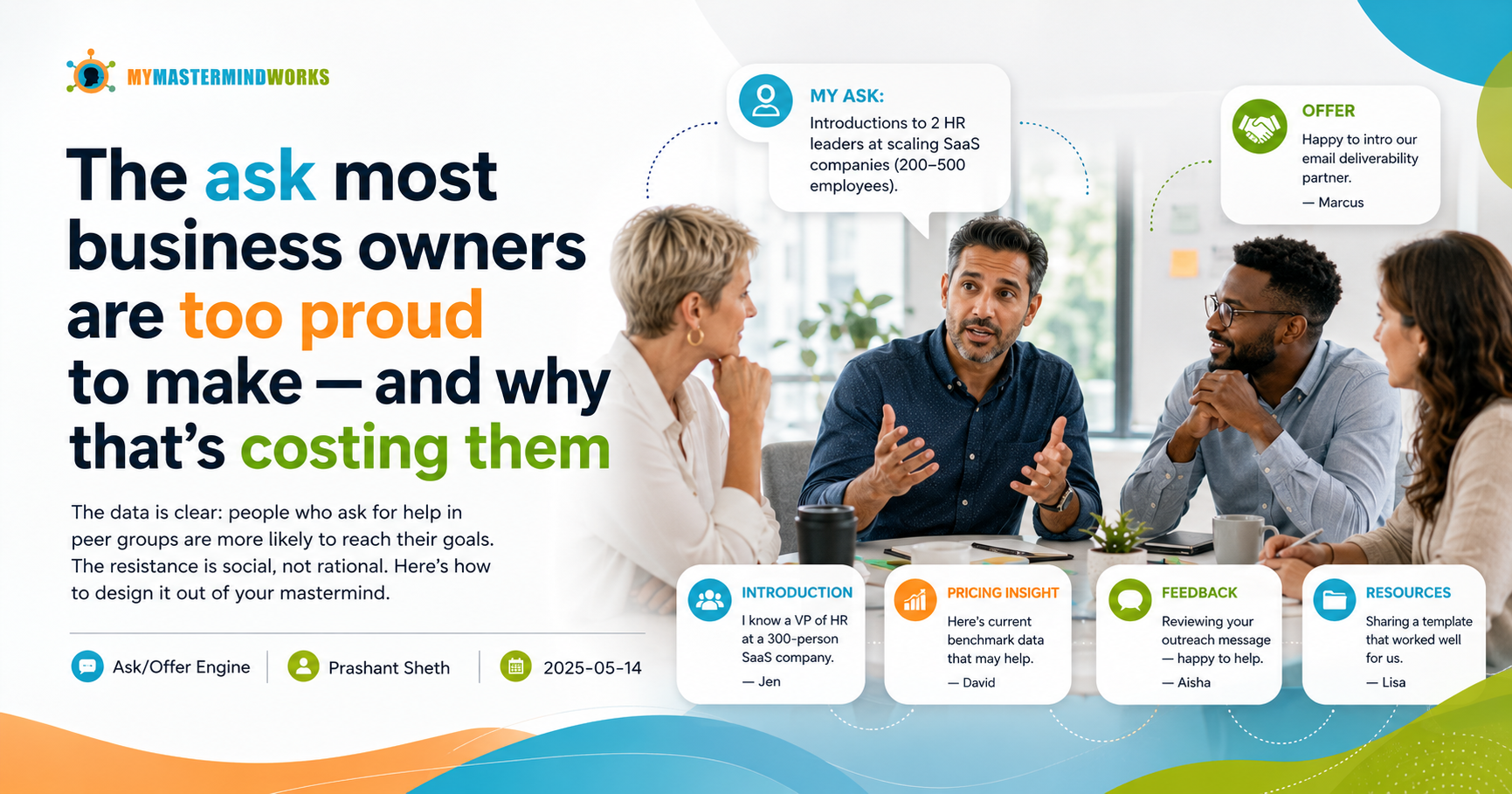
There is a specific kind of business owner who is very good at helping other people and very bad at asking for help themselves.
You probably know one. You might be one.
They show up to mastermind sessions with thoughtful responses to everyone else’s challenges. They make introductions generously. They share resources without being asked. And when it’s their turn to speak, they give a confident update that makes everything sound under control — even when it isn’t.
This person is, in the language of peer accountability research, a high contributor with a low return. They put a lot in and quietly get very little out. And the reason is almost never about the quality of the group. It’s about the specific social cost of asking.
Why asking feels dangerous
The resistance to asking for help in a professional peer group is not irrational. It’s a reasonable response to a real pattern: in most professional environments, asking for help signals weakness, uncertainty, or incompetence. You learn early that the people who thrive are the ones who have answers, not questions.
Masterminds are supposed to be different. The whole premise is that asking is valued, that no one is expected to have all the answers, that the collective intelligence of the group is the point. But the premise doesn’t automatically override the learned behavior. You can tell someone it’s safe to ask and they’ll still not ask, because the felt sense of risk doesn’t respond to reassurance — it responds to evidence.
The evidence it’s looking for: does asking actually work here? Do people respond? Does something real happen when I put a specific request out?
The difference between vague sharing and a real ask
Most mastermind members, when they “ask for help,” do something that sounds like asking but functions like sharing. They say things like:
“I’m trying to figure out my pricing strategy.”
“I need to get better at marketing.”
“I’m working on building my team.”
These are topics, not asks. They invite conversation but don’t create coordination. Nobody in the room knows what to do with them, so they respond with questions, suggestions, and encouragement — which feels supportive but rarely produces anything the person can act on before next session.
A real ask is a specific request for a specific thing from a specific kind of person:
“I need an introduction to a commercial real estate attorney in Austin who works with small businesses. Does anyone know someone they’d recommend?”
“I’m trying to understand how other coaches in this room price their group programs. Would two of you be willing to share your actual numbers with me privately this week?”
“I need someone who has built a referral system to look at mine and tell me what’s broken. Can anyone commit thirty minutes to that before Thursday?”
The specificity is what makes the ask workable. When the request is concrete, people can either fulfill it or they can’t. There’s no ambiguity about what a good response looks like. And when someone does respond, the person who asked gets something they can actually use.
How to design asking into the structure
The insight from behavioral design is that you can’t reliably change how people feel about asking. You can change what they’re required to do before they speak.
If the structure of your mastermind requires every member to arrive with a written ask — specific, actionable, directed at a real gap in their current plan — then asking is no longer a choice they make in the moment under social pressure. It’s a prerequisite for participating. The social cost disappears because the behavior is normalized. Everyone is asking. Asking is what you do here.
The offer structure works the same way. When every member also arrives with a written offer — something specific they’re willing to provide to the group this session — the dynamic shifts from a room of people waiting to be helped to a room of people ready to help. The energy is completely different.
This is why the Ask/Offer mechanic isn’t just a feature — it’s the thing that makes the accountability structure actually function. Without it, masterminds drift back toward narrative updates and peer cheerleading. With it, they become genuine coordination engines where help gets to the people who need it.
What happens when it works
The members who ask the most tend to grow the fastest — not because asking is magic, but because asking forces clarity. To write a real ask, you have to know what you actually need. Most people are vague about their needs not because they’re hiding something but because they’ve never been required to be specific about it.
The discipline of the ask is, in a real sense, the discipline of self-knowledge applied to professional growth. What do I actually need right now, from a specific person, that would meaningfully move my situation forward?
When you can answer that question, and when you’re in a room of people who can answer it too, the group stops being a support network and starts being something closer to what Napoleon Hill described: a coordinated intelligence working in service of each member’s definite purpose.
That’s not a metaphor. That’s a system. And systems can be built.
This post is part of The Mastermind Journal — thinking on peer accountability, group coordination, and what it actually takes to build a business in community. Written by Prashant Sheth, founder of MyMastermindWorks.
Prashant Sheth is the founder of MyMastermindWorks and the HumanismOS ecosystem. He has spent fifteen years studying the conditions under which humans coordinate effectively.
Enjoyed this? Get the next one.
The Mastermind Journal lands in your inbox when there's something worth saying.