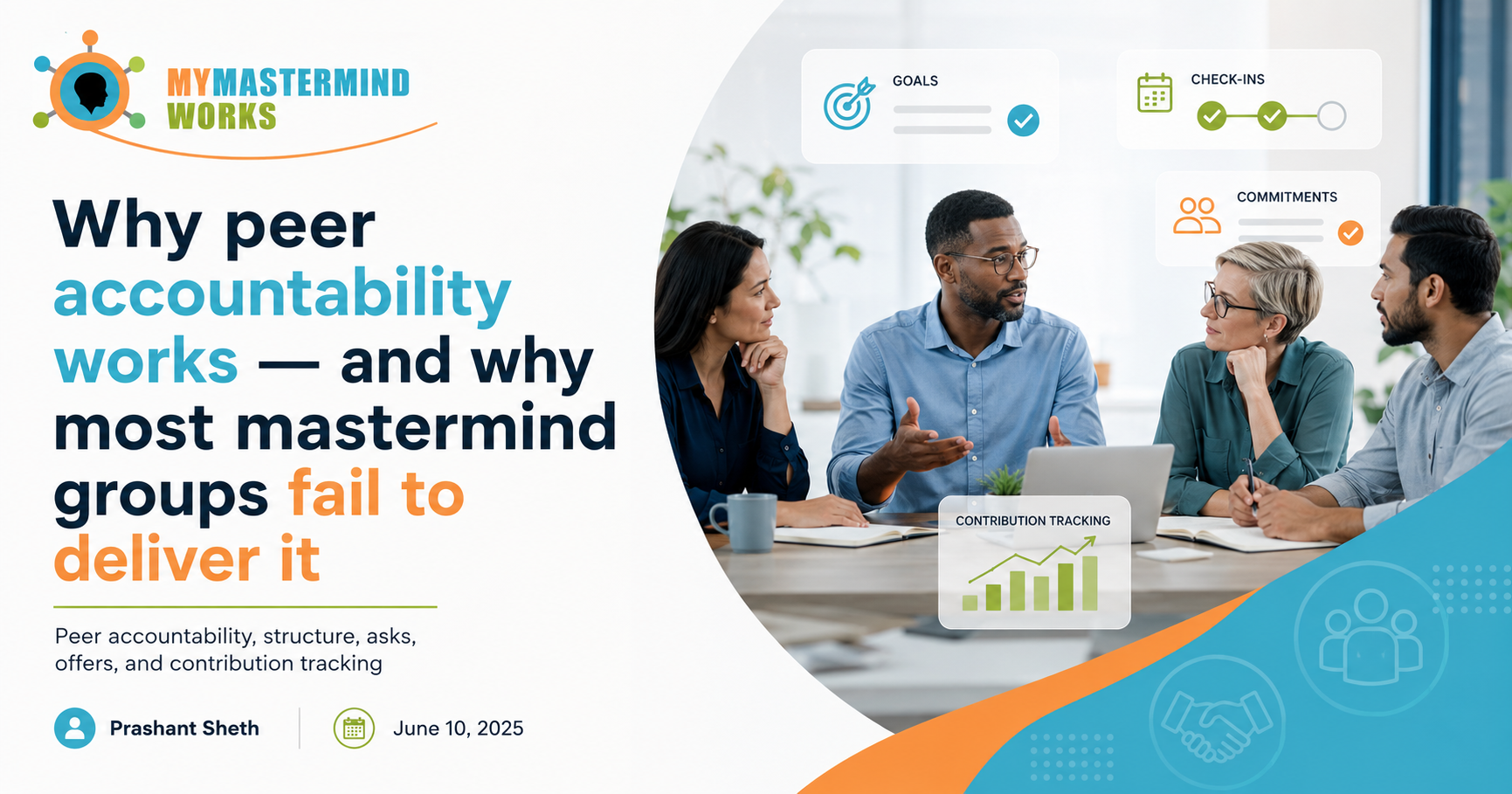
Why peer accountability works — and why most mastermind groups fail to deliver it
Napoleon Hill published Think and Grow Rich in 1937. In it, he described what he called the “mastermind principle” — the idea that two or more minds, working in harmony toward a definite purpose, create a third, invisible intelligence greater than the sum of its parts. He called it the most important principle in the book.
Eighty-seven years later, thousands of coaches, consultants, and business leaders have built entire careers around running mastermind groups. And most of those groups quietly fail to deliver the one thing they promise: genuine accountability.
Here’s why — and what actually works instead.
What behavioral science actually says about accountability
The research on accountability is older and more rigorous than most facilitators realize. A 2015 study by the American Society of Training and Development found that people who commit to a goal with a specific accountability appointment have a 65% chance of completing it — compared to 10% if they simply decide to do it, and 25% if they tell someone else about it.
The mechanism isn’t social pressure. It’s cognitive load reduction. When someone else knows what you’re supposed to do, part of the mental task of remembering to do it transfers to the relationship. The commitment becomes a shared artifact, not a private intention.
This is why written goals outperform mental ones, why public commitments outperform private ones, and why structured peer groups outperform vague “accountability partnerships.” Structure doesn’t constrain the goal — it carries it.
The three things most facilitators do that accidentally undermine accountability
1. They make accountability relational rather than structural.
The most common mastermind format: members share updates, other members respond with encouragement or questions, the facilitator wraps up. The problem is that this makes accountability entirely dependent on whether members show up, whether they remember what someone said last session, and whether anyone feels comfortable naming a missed commitment.
When accountability is relational, it disappears the moment the relationship gets awkward. And in a group of ambitious people, relationships get awkward the moment someone falls behind.
Structural accountability is different. It means the commitment is written down and visible, the progress is tracked against a baseline, and the gap between where someone said they’d be and where they are is surfaced automatically — not by someone who has to decide whether to say something uncomfortable.
2. They confuse talking about the goal with working on the goal.
Masterminds where members spend most of their time discussing what they’re going to do are masterminds where members feel busy without moving. The session becomes the substitute for the work, not the catalyst for it.
The best mastermind sessions are short on sharing and long on specific requests for help. The member who says “I need three introductions to commercial real estate attorneys in Austin before next session” is doing more work in that sentence than the member who spends ten minutes explaining their quarterly strategy.
The Ask/Offer model is the fix. When members are required to show up with a specific ask and at least one specific offer, the conversation shifts from narrative to coordination. People leave with something they didn’t have when they arrived.
3. They track attendance instead of contribution.
Showing up is not the same as contributing. A member can attend every session, say thoughtful things, and never once ask for help, offer specific assistance to a peer, or do anything that moves someone else’s needle. That member will still feel like they’re “in” the mastermind while extracting almost nothing from it.
Contribution tracking changes the incentive. When every ask, offer, peer response, plan feedback, and acknowledged milestone accrues into a visible score, members understand for the first time that the value they get is proportional to the value they put in — not to how many sessions they attended.
What a functioning accountability structure actually looks like
A member’s goal needs to exist in writing, visible to the people who could help them hit it. Their milestones need to be specific enough that anyone in the group can tell whether they’ve been hit. Their asks need to be real requests for real things, not vague expressions of what they’re working on.
And when a milestone is missed, someone — ideally the system, not another member — needs to surface that gap before it becomes a month of missed milestones that nobody mentioned because it felt awkward.
This is infrastructure, not culture. Culture matters enormously in a mastermind, but culture can’t substitute for structure. The two work together: structure makes the right behavior easy and the wrong behavior visible; culture makes the right behavior feel good and the wrong behavior feel genuinely uncomfortable.
Build the structure first. The culture follows.
Prashant Sheth is the founder of MyMastermindWorks and the HumanismOS ecosystem. He has spent fifteen years studying the conditions under which humans coordinate effectively — and building the infrastructure to make it easier.
Prashant Sheth is the founder of MyMastermindWorks and the HumanismOS ecosystem. He has spent fifteen years studying the conditions under which humans coordinate effectively.
Enjoyed this? Get the next one.
The Mastermind Journal lands in your inbox when there's something worth saying.